
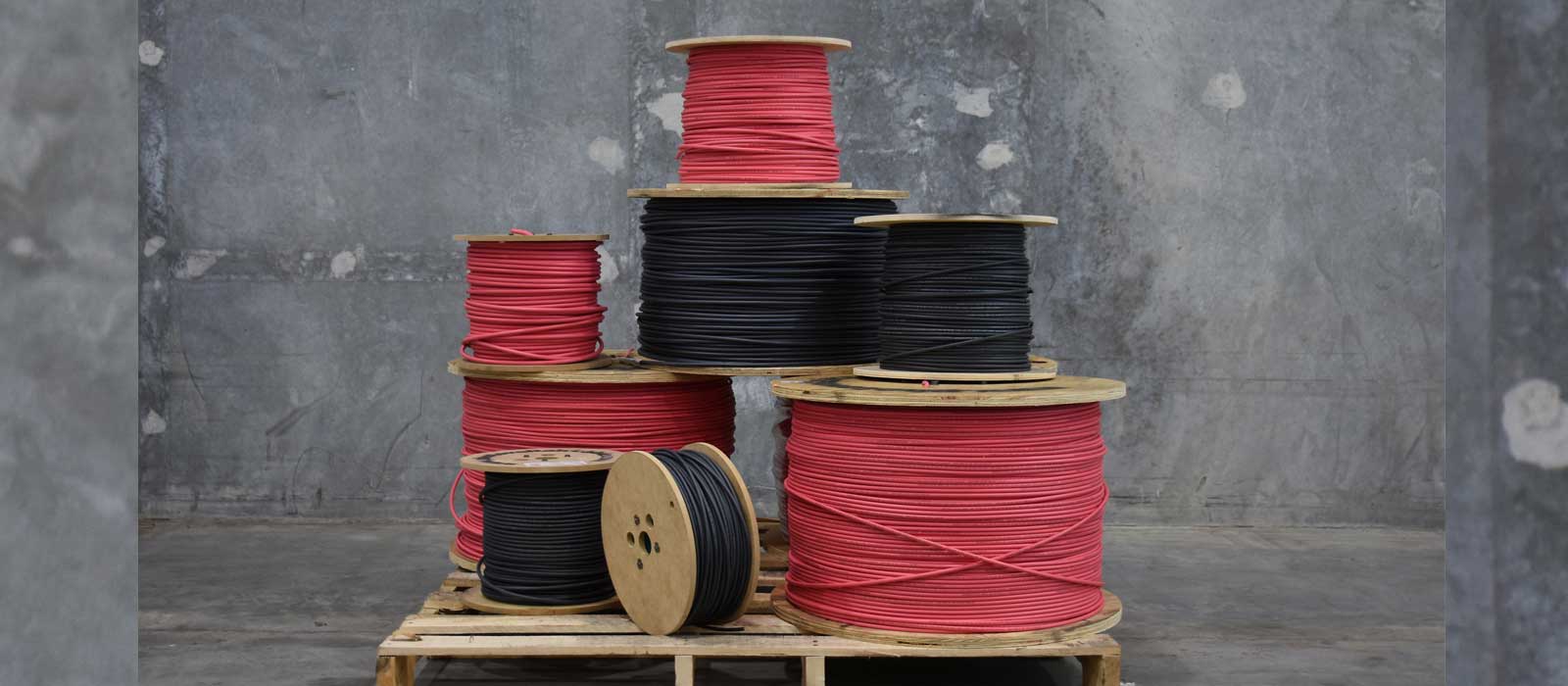
UL 4703 Photovoltaic Wire: Why Certification Matters and How to Choose the Right AWG for Your Solar Installation
When designing or installing a solar PV system, every component in the string — from the panel terminals to the inverter input — must be rated, sized, and certified for the unique demands of photovoltaic applications. Among those components, the wire is arguably the most overlooked. Many installers default to general-purpose building wire such as THHN or THWN, not realizing that PV environments impose conditions — continuous DC current, prolonged UV exposure, wide temperature swings, potential contact with roofing materials — that those conductors were never designed to handle.
UL 4703 is the safety standard developed specifically for photovoltaic wire, and it defines exactly what a conductor must endure to earn the right to live inside a solar array for 25+ years. In this guide, we break down what UL 4703 means, how it compares to alternative wire types, and how to select the correct AWG gauge to balance safety, code compliance, and system efficiency.
|
💡 This article is intended for solar installers, electrical engineers, and project managers who want to understand the technical basis of PV wire selection — not just which part number to order, but why. Jump to Section 4 for the AWG selection guide if you need a quick reference. |
1. Understanding UL 4703: The Standard Behind PV Wire
UL 4703 — formally titled "Photovoltaic Wire" — is the product safety standard published by Underwriters Laboratories that establishes the construction and performance requirements for single-conductor insulated wire used in the wiring of photovoltaic power systems. First released in 2005 and now in its fourth revision, it is referenced directly by the National Electrical Code (NEC) Article 690, which governs all PV system wiring in the United States.
What UL 4703 requires a wire to withstand
To earn a UL 4703 listing, a wire must pass an extensive battery of tests that includes:
· Sunlight resistance: Prolonged UV exposure without cracking, delamination, or significant loss of insulation integrity.
· Low-temperature flexibility: Bending at −40 °C without cracking — critical for cold-climate rooftop installs.
· Flame resistance: Self-extinguishing behavior to prevent fire propagation through conduit runs.
· Oil resistance: Protection against roofing compounds, solvents, and cleaning agents common on commercial flat roofs.
· Wet insulation resistance: Maintained electrical isolation after prolonged water immersion.
· Mechanical abuse: Crush strength, impact resistance, and abrasion resistance to survive installation handling and long-term service.
Voltage and temperature ratings under UL 4703
UL 4703 covers three voltage classes: 600 V, 1000 V, and 2000 V. The 2000 V rating is the current industry standard for modern string inverter and DC optimizer systems, offering greater design flexibility and headroom for high-voltage string configurations. Temperature ratings include 90 °C (wet and dry), 105 °C, 125 °C, and 150 °C (dry), giving engineers multiple options for high-ambient-temperature installations such as desert utility-scale projects.
The USE-2 / RHH / RHW-2 dual listing
Most UL 4703 PV wire carries a dual or triple listing: USE-2 (Underground Service Entrance), RHH (Thermoset insulation, dry), and RHW-2 (Thermoset insulation, wet). This combination makes the wire code-compliant for both exposed outdoor routing and conduit runs, simplifying the transition from array wiring to the combiner box or inverter without a change in conductor type.
|
✅ A wire stamped with 'UL 4703 USE-2 RHH/RHW-2 2000V' on its jacket is fully compliant for outdoor rooftop and ground-mount PV installations, conduit runs, and direct-burial applications (in conduit) per NEC Article 690. All PV Wire sold by PhotovoltaicCable.com carries this listing. |
2. UL 4703 PV Wire vs. Alternative Conductors: A Side-by-Side Comparison
A common question on job sites and in engineering reviews: "Can I use THHN, THWN-2, or USE-2 wire instead of UL 4703 PV wire?" The short answer is: sometimes partially, but never as a complete substitute in the array wiring section (panel terminals to combiner or inverter). Here is why:
|
Property |
UL 4703 PV Wire |
THHN / THWN-2 |
USE-2 (non-PV) |
THWN in Conduit |
|
Voltage Rating |
600 / 1000 / 2000 V |
600 V only |
600 V only |
600 V only |
|
Outdoor / Exposed UV |
✅ Yes — rated |
❌ No |
✅ Yes |
❌ No |
|
Max Temp (dry) |
90–150 °C |
90 °C |
90 °C |
90 °C |
|
Max Temp (wet) |
90 °C |
75 °C |
90 °C |
90 °C |
|
Low-temp flexibility |
✅ −40 °C |
⚠️ Not tested |
⚠️ Limited |
⚠️ Not tested |
|
Flame resistance |
✅ Yes |
✅ Yes |
⚠️ Partial |
✅ Yes |
|
Oil resistance |
✅ Yes |
❌ No |
⚠️ Limited |
❌ No |
|
NEC 690.31 compliant |
✅ Yes |
❌ Not in array |
⚠️ Older installs |
✅ In conduit only |
|
Insulation material |
XLPE (crosslinked PE) |
PVC / Nylon |
XLPE/EPR |
PVC / LSZH |
|
Expected service life |
25–40 years |
15–20 years outdoor |
20–30 years |
15–20 years outdoor |
|
Typical cost |
Medium |
Lower |
Lower–Medium |
Lower |
Why XLPE insulation matters
Unlike PVC (used in THHN/THWN), cross-linked polyethylene (XLPE) has a three-dimensional polymer network that resists deformation at high temperatures, retains flexibility at low temperatures, and provides superior resistance to water absorption and chemical attack. In a rooftop environment where module temperatures can exceed 70 °C and wires rest against hot roofing membranes, XLPE insulation maintains its dielectric properties where PVC would soften, deform, and eventually fail.
3. Construction of PhotovoltaicCable.com 2000 V PV Wire
Understanding the physical construction of the cable helps explain why it performs the way it does under real-world installation and service conditions.
|
Layer |
Specification |
Purpose |
|
Conductor |
Bare annealed copper, 19-strand Class B |
Flexibility, conductivity, corrosion resistance |
|
Insulation |
XLPE (Cross-Linked Polyethylene) |
Thermal/dielectric performance, UV and chemical resistance |
|
Jacket |
Integrated with insulation (single-layer) |
Sunlight, oil, flame, and mechanical protection |
|
Voltage |
2000 V DC |
Supports modern high-voltage string configurations |
|
Temp Range |
−40 °C to +90 °C (wet); up to +150 °C (dry UL listing) |
Cold-climate and high-ambient-temp installs |
|
Listing |
UL 4703 / USE-2 / RHH / RHW-2 |
Full NEC 690 compliance for all PV wiring methods |
|
Colors |
Black and Red (standard) |
Polarity identification per NEC 690.31(A) |
|
Origin |
Made in USA |
Quality assurance; meets UL factory inspection |
|
Reels |
500 ft / 1,000 ft / 2,500 ft / 5,000 ft |
Optimized for residential through utility-scale |
Why 19 strands instead of 7?
Higher strand count in the conductor means greater flexibility. A 7-strand conductor is stiffer and more prone to work hardening at connection points (MC4 connectors, combiner terminals) under repeated thermal cycling. The 19-strand construction of PhotovoltaicCable.com PV wire bends more easily around rafter obstacles, through tight conduit bends, and into compact combiner box lugs — reducing installation time and the risk of insulation damage from overbending.
2000 V rating: the practical advantage
Modern string inverters from manufacturers like SolarEdge, Enphase IQ8, Fronius, and SMA are designed for maximum DC input voltages of 600 V to 1500 V. Using 2000 V rated wire provides a safety margin above the highest open-circuit voltage (Voc) that can be reached under cold-temperature conditions, where PV module Voc increases as temperature drops. NEC 690.7 requires calculating the maximum system voltage considering the lowest expected temperature — a 2000 V wire eliminates virtually all concern about exceeding the conductor voltage rating in any real-world residential or commercial installation.
4. How to Select the Correct AWG Gauge: The Complete Guide
Wire gauge selection for a PV system is governed by two independent criteria — and the final answer is always the larger (heavier) gauge that satisfies both:
· Ampacity: the wire must safely carry the maximum continuous current without exceeding its thermal rating.
· Voltage drop: the resistance of the wire must not cause a voltage loss that meaningfully reduces system output.
These two constraints frequently point to different gauges. A short, high-current run may be ampacity-limited; a long, low-current run may be voltage-drop-limited. Always check both.
4.1 Ampacity Table for UL 4703 PV Wire (Copper, 90 °C)
The following base ampacity values apply to a single conductor in free air at 40 °C ambient. Correction factors must be applied for higher ambient temperatures and conduit fill (see 4.2).
|
AWG |
Stranding |
Conductor Area (mm²) |
Base Ampacity @ 90°C |
Typical Application |
|
12 AWG |
19-strand |
3.3 mm² |
40 A |
Small residential strings, short runs |
|
10 AWG |
19-strand |
5.3 mm² |
55 A |
Standard residential rooftop systems |
|
8 AWG |
19-strand |
8.4 mm² |
80 A |
High-current strings, medium commercial |
|
6 AWG |
19-strand |
13.3 mm² |
105 A |
Commercial arrays, long homerun runs |
|
4 AWG |
19-strand |
21.2 mm² |
140 A |
Large commercial, combiner outputs |
|
2 AWG |
19-strand |
33.6 mm² |
170 A |
Large combiner to inverter home runs |
|
1/0 AWG |
19-strand |
53.5 mm² |
230 A |
Utility-scale, high-current DC circuits |
|
2/0 AWG |
19-strand |
67.4 mm² |
265 A |
Utility-scale centralized inverter feeds |
4.2 Temperature Correction Factors
NEC Table 310.15(B)(2)(a) requires reducing the ampacity of any conductor when the ambient temperature exceeds 40 °C. Rooftop PV installations — particularly wires lying on or near a dark roofing membrane — routinely see ambient temperatures of 50 °C to 70 °C during summer operation. Failing to apply these correction factors is one of the most common design errors in residential solar, leading to insulation degradation over time.
|
Ambient Temp (°C) |
Correction Factor (90°C rated wire) |
Effect on 10 AWG (55 A base) |
|
Up to 40 °C |
1.00 |
55 A — no derating |
|
41 – 50 °C |
0.91 |
50 A effective |
|
51 – 60 °C |
0.82 |
45 A effective |
|
61 – 70 °C |
0.71 |
39 A effective |
|
71 – 80 °C |
0.58 |
32 A effective |
|
81 – 90 °C |
0.41 |
23 A effective |
|
⚠️ ⚠️ Real-world example: A 10 AWG wire on a black TPO rooftop in Phoenix (ambient 70 °C) has an effective ampacity of only 39 A — not 55 A. If your string produces a continuous DC current above 39 A, you must upsize to 8 AWG or higher. Ignoring this derate is a code violation under NEC 110.14(C) and a potential fire hazard. |
4.3 NEC Continuous Current Multiplier (125% Rule)
NEC 690.8(A) requires that PV source circuit conductors be sized for at least 125% of the module's rated short-circuit current (Isc). This accounts for the fact that photovoltaic systems are treated as continuous loads (operating more than 3 hours continuously). The calculation is:
Minimum conductor ampacity ≥ Isc × 1.25
For a module with Isc = 10 A, the minimum conductor ampacity after all derating must be ≥ 12.5 A. For a series string, the current is the same as a single module Isc. For parallel-connected strings feeding a combiner, multiply by the number of strings. Always apply temperature correction and conduit fill derating before comparing to this minimum.
4.4 Voltage Drop: Keeping Energy Loss Below 2%
The NEC does not mandate a specific maximum voltage drop for PV circuits, but the industry standard recommendation — and best practice for system performance — is to keep DC voltage drop below 2% for source circuits (panel strings to combiner) and below 1.5% for the combiner-to-inverter homerun, for a combined DC total of no more than 3–4%.
The voltage drop formula for a single-conductor DC circuit is:
Vdrop (%) = (2 × L × I × R) / (1000 × V) × 100
Where: L = one-way length in feet, I = current in amps, R = resistance per 1000 ft (Ω/kft), V = system voltage
4.5 Resistance Reference Table (Copper, 75 °C)
|
AWG |
Resistance (Ω per 1000 ft) |
Max one-way run at 2% VD / 10 A / 600 V |
|
12 AWG |
1.93 Ω/kft |
~311 ft |
|
10 AWG |
1.21 Ω/kft |
~496 ft |
|
8 AWG |
0.764 Ω/kft |
~785 ft |
|
6 AWG |
0.491 Ω/kft |
~1,222 ft |
|
4 AWG |
0.308 Ω/kft |
~1,948 ft |
|
2 AWG |
0.194 Ω/kft |
~3,093 ft |
|
1/0 AWG |
0.122 Ω/kft |
~4,918 ft |
4.6 Practical AWG Selection Guide by System Type
|
System Type |
Typical String Current |
Typical Run Length |
Recommended AWG |
|
Small residential (3–8 kW) |
8–12 A Isc |
20–60 ft |
10 AWG |
|
Mid-size residential (8–15 kW) |
10–14 A Isc |
30–100 ft |
10 AWG (short) / 8 AWG (long) |
|
Large residential / small commercial |
12–18 A Isc |
50–150 ft |
8 AWG |
|
Commercial rooftop (50–250 kW) |
15–25 A Isc |
100–400 ft |
6 AWG |
|
Commercial homerun / combiner output |
50–150 A |
100–500 ft |
4–1/0 AWG |
|
Utility-scale ground mount |
150–500+ A |
200–1000 ft |
1/0–500 MCM |
5. NEC Article 690 Compliance: Key Code Requirements for PV Wiring
For installers operating in the United States, the following NEC 690 provisions directly govern wire selection and installation:
NEC 690.31(A) — Wiring Methods
Requires that PV source and output circuit conductors be listed for the application. UL 4703 / USE-2 / RHH / RHW-2 rated wire satisfies this requirement for exposed outdoor wiring without conduit.
NEC 690.7 — Maximum Voltage
All conductors and components must be rated for the maximum system voltage, calculated per the lowest expected temperature. The 2000 V rating of PhotovoltaicCable.com PV wire provides compliance margin for virtually all residential and commercial string configurations.
NEC 690.8(A) — Ampacity Sizing
Conductors must be sized at ≥ 125% of the maximum circuit current (Isc for source circuits). After applying the 125% factor, all NEC derating factors (temperature, conduit fill) must still be satisfied.
NEC 690.31(E) — Multiconductor Cable
When PV wire is installed in conduit that also contains other circuits, the standard conduit fill and ampacity correction rules of NEC Article 310 apply.
NEC 690.31(G) — Bipolar PV Systems
Requires that conductors of opposite polarity in a bipolar system be identified and that appropriate voltage ratings be maintained. The black (negative) and red (positive) color coding of PV wire supports this requirement.
NEC 705.12 — Point of Connection
Governs the transition from DC PV wiring to the AC interconnection point. The PV wire must terminate correctly at the inverter or combiner; field connections must use listed MC4 or equivalent connectors rated for the wire gauge and system voltage.
6. Common Mistakes in PV Wire Selection and Installation
Based on field experience and AHJ (Authority Having Jurisdiction) inspection reports, these are the most frequent errors encountered with PV system wiring:
Mistake #1: Using THHN or THWN in the array section
THHN is only rated for 600 V and is not listed for outdoor or exposed sunlight use. It will degrade within 2–5 years in direct sun exposure, leading to insulation cracking, ground faults, and potential arc flash events. Use UL 4703 PV wire for all array wiring.
Mistake #2: Ignoring temperature correction on rooftop runs
Upsizing from 10 AWG to 8 AWG on a hot rooftop (60–70 °C ambient) is not overengineering — it is a code requirement. The derated ampacity of 10 AWG at 70 °C is only ~39 A, which may be insufficient for strings with Isc above 31 A (31 × 1.25 = 38.75 A).
Mistake #3: Undersizing for voltage drop on long homerun runs
In large ground-mount or commercial rooftop systems, the distance from the furthest string combiner to the inverter can exceed 300–500 feet. At these distances, 10 AWG or even 8 AWG will produce unacceptable voltage drop and annual energy loss. Calculate VD before specifying.
Mistake #4: Mixing wire gauges in the same string
Combining 12 AWG and 10 AWG segments in the same string circuit (e.g., short pigtails + long run) means the entire circuit is limited by the ampacity and voltage drop of the smaller gauge.
Mistake #5: Using non-UV-rated wire ties and clips
Even with correctly specified PV wire, using standard nylon zip ties (rated only to 60–75 °C) to secure the wiring under panels is a common failure point. Use UV-stabilized stainless steel or UV-rated nylon hardware.
Mistake #6: Not verifying the full UL listing on the jacket print
Some off-brand wires carry partial listings or counterfeit marks. Verify that the jacket print includes the full listing string: UL 4703 / USE-2 / RHH / RHW-2 / Voltage Rating / Temperature Rating. If any element is missing, the wire may not be compliant.
7. Available Products at PhotovoltaicCable.com
PhotovoltaicCable.com offers a comprehensive range of UL 4703-listed copper PV wire in both black and red, covering all standard residential and commercial gauge requirements. All products are Made in USA, ship same day, and are available in installer-friendly reel sizes.
|
SKU / Gauge |
Voltage |
Color(s) |
Reel Sizes Available |
Typical Use |
|
12 AWG PV Wire |
2000 V |
Black / Red |
500 ft, 1,000 ft |
Small residential strings |
|
10 AWG PV Wire |
2000 V |
Black / Red |
500 ft, 1,000 ft, 2,500 ft |
Standard residential PV |
|
8 AWG PV Wire |
2000 V |
Black / Red |
500 ft, 1,000 ft, 2,500 ft |
High-current / long runs |
|
6 AWG PV Wire |
2000 V |
Black / Red |
500 ft, 1,000 ft, 2,500 ft |
Commercial rooftop arrays |
|
Aluminum PV Wire 500 MCM |
2000 V |
Black |
Custom reels |
Utility-scale homerun conductors |
|
📦 All reels ship same day when ordered before 3 PM EST. Free shipping is available on qualifying orders. Custom cut lengths available for large commercial and utility-scale projects. Visit www.photovoltaiccable.com/collections/pv-wire-2000-volts for current pricing and availability. |
8. Frequently Asked Questions
Q: Can I use UL 4703 PV wire for both indoor and outdoor portions of the system?
A: Yes. The USE-2 / RHH / RHW-2 dual listing allows UL 4703 PV wire to be used in conduit, inside combiner boxes, and through building penetrations, as well as for outdoor exposed wiring in the array. This simplifies procurement and ensures a single conductor type from panel to inverter.
Q: Is 2000 V PV wire required, or is 600 V sufficient?
A: 600 V wire is permissible for systems where the maximum calculated DC voltage does not exceed 600 V. However, most modern string inverter systems operate at maximum input voltages up to 1000 V–1500 V, making 600 V wire insufficient and non-compliant. 2000 V wire is the safest and most future-proof choice for any new installation.
Q: What is the difference between USE-2 and UL 4703 PV wire?
A: USE-2 alone (without the UL 4703 listing) meets fewer performance requirements than full UL 4703-listed wire. UL 4703 wire is superior in low-temperature flexibility, sunlight resistance, and flame retardancy. For new installations, always specify UL 4703; USE-2-only wire was more common in systems installed before 2010.
Q: How do I handle the transition from red/black PV wire to the conduit run into the house?
A: UL 4703 USE-2/RHH/RHW-2 wire can run directly from the array through conduit into the inverter without any transition. If you need to transition to THWN inside a junction box within conduit, that is permissible per NEC 690.31, but the junction box must be accessible and the transition must occur inside an enclosure, not through an MC4 connector.
Q: Do the ampacity values change when wire is installed in conduit?
A: Yes. When three or more current-carrying conductors are installed in the same conduit, NEC Table 310.15(C)(1) requires an additional derating factor: 0.70 for 4–6 conductors, 0.50 for 7–9 conductors, etc. This is in addition to the temperature correction factor. Always apply both if applicable.
9. Conclusion: The Right Wire Is the Foundation of a 25-Year System
Photovoltaic systems are designed and warranted to produce energy for 25 to 30 years. The modules, inverters, and racking are all sized and tested for that service life. The wire needs to be too — and that is precisely what the UL 4703 standard guarantees. XLPE insulation, sunlight resistance, low-temperature flexibility, and a 2000 V rating are not premium features. They are minimum requirements for a reliable solar installation.
Selecting the correct AWG gauge — sized for both ampacity (with all applicable derating factors) and voltage drop — directly impacts the safety and economic performance of the system. An undersized wire is a code violation, a thermal hazard, and a source of annual energy loss. An oversized wire is a minor cost premium on the front end that pays for itself in reliability and reduced maintenance over the life of the project.
PhotovoltaicCable.com provides UL 4703 / USE-2 / RHH / RHW-2 rated copper PV wire in 6–12 AWG and larger, Made in USA, with same-day shipping in installer-ready reel sizes. Whether you are wiring a 5 kW residential rooftop or a 500 kW commercial ground-mount, the right conductor starts with the right listing.
|
🛒 Shop the full line of 2000 V UL 4703 PV Wire at: |