
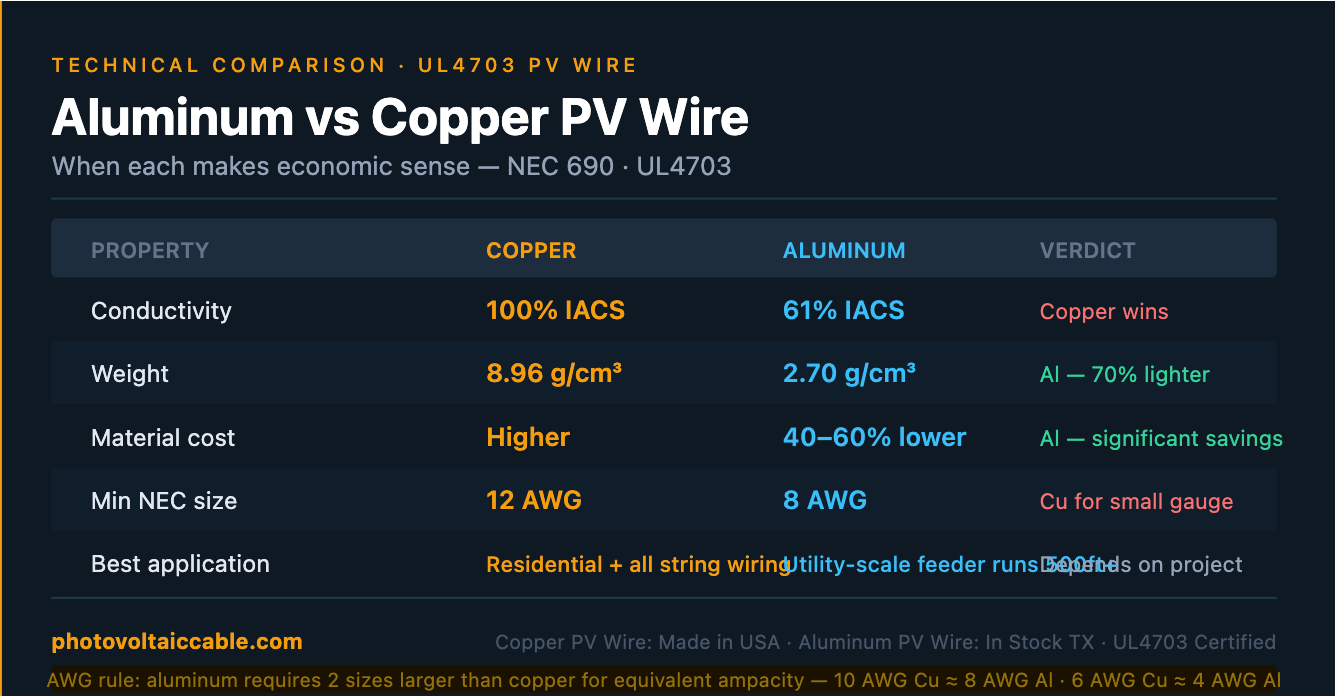
For most residential solar installations, copper PV wire is the right choice. But for utility-scale projects, large ground-mount arrays, and long DC feeder runs over 500 feet, aluminum PV wire can reduce material costs by 40–60% while meeting the same NEC 690 requirements — if sized correctly.
This guide covers the technical and economic differences between aluminum and copper UL4703 PV wire, when each is the right specification, and the sizing adjustments required when switching from copper to aluminum conductors.
Contents
1. Material properties — conductivity, weight and cost
Copper and aluminum are both viable conductor materials for UL4703 PV wire, but their physical properties differ significantly — and those differences drive every sizing and installation decision.
| Property | Copper | Aluminum | Aluminum vs Copper |
|---|---|---|---|
| Electrical conductivity | 100% IACS | 61% IACS | 39% lower conductivity |
| Weight (relative) | 8.96 g/cm³ | 2.70 g/cm³ | 70% lighter |
| Material cost (relative) | Higher — tracks copper LME | Lower — tracks aluminum LME | 40–60% lower per pound |
| Thermal expansion | 17 µm/m°C | 23 µm/m°C | 35% higher — requires AL-rated connectors |
| Oxidation | Low — oxide is conductive | Higher — oxide is resistive | Requires anti-oxidant compound at terminations |
| Tensile strength | 210–250 MPa | 90–200 MPa | Lower — requires careful handling on large reels |
2. Ampacity comparison — why aluminum needs a larger gauge
Because aluminum has lower conductivity than copper, an aluminum conductor of the same AWG carries significantly less current. NEC Table 310.15(B)(16) reflects this with separate ampacity columns for copper and aluminum conductors at the same temperature rating.
| AWG | Copper ampacity at 90°C | Aluminum ampacity at 90°C | Copper equivalent for aluminum |
|---|---|---|---|
| 12 AWG | 30 A | Not permitted (NEC 310.15) | — |
| 10 AWG | 40 A | Not permitted (NEC 310.15) | — |
| 8 AWG | 55 A | 40 A | ≈ 10 AWG copper |
| 6 AWG | 75 A | 55 A | ≈ 8 AWG copper |
| 4 AWG | 95 A | 75 A | ≈ 6 AWG copper |
| 2 AWG | 130 A | 100 A | ≈ 4 AWG copper |
| 1/0 AWG | 170 A | 135 A | ≈ 2 AWG copper |
3. NEC requirements for aluminum PV conductors
NEC Article 690 permits aluminum conductors in PV systems subject to the following requirements:
- Minimum size: 8 AWG for aluminum PV conductors per NEC 310.15(B)(16)
- Terminations: must be rated for aluminum (marked AL or AL/CU) — copper-only terminals cause galvanic corrosion
- Anti-oxidant compound: required at all aluminum conductor terminations to prevent resistive oxide layer formation
- Connectors: solar panel connectors must be rated and tested for aluminum conductors — standard copper-rated connectors are not acceptable
- Ampacity derating: same temperature and bundling derating factors apply as for copper — use the aluminum column of Table 310.15(B)(16)
- Voltage drop: aluminum's higher resistance means voltage drop calculations are more critical — always verify with the full NEC 690.8 calculation
500 MCM Aluminum PV Wire 2kV UL4703 — In Stock
Utility-scale aluminum PV wire. Ships same or next business day from LaPorte, TX.
View Aluminum PV Wire →4. When aluminum makes economic sense
Aluminum PV wire delivers its best economic case when three conditions align:
Conditions where aluminum wins economically
Typical projects where aluminum is specified:
- Utility-scale solar farms with DC feeder runs exceeding 500 ft
- Large commercial ground-mount arrays with central inverters
- Projects with tight material budgets where the AHJ accepts aluminum PV conductors
- EPC contractors with experienced crews familiar with AL termination procedures
5. When copper is the right choice
Despite aluminum's cost advantage on large projects, copper remains the standard specification for most solar installations for good reason:
- All residential and small commercial installations — aluminum below 8 AWG is not NEC-permitted, so copper is the only option for 10 and 12 AWG string wiring
- Module-level wiring — panel-to-panel connections always use copper solar connectors and copper PV wire regardless of system size
- Short feeder runs under 300 ft — the gauge upsize for aluminum partially offsets savings; copper is often more cost-effective at this scale
- High-vibration environments — aluminum's lower tensile strength makes it more susceptible to fatigue cracking in wind-exposed installations
- Projects requiring Made in USA certification — our copper PV wire is manufactured in the USA; confirm origin requirements with your project owner before substituting aluminum
6. Real-world cost comparison
The following example compares copper vs aluminum for a 1,000 ft DC feeder run (500 ft one-way) at a commercial ground-mount installation requiring 60A ampacity after derating.
Scenario: 1,000 ft feeder run, 60A required ampacity after derating
| Item | Copper option | Aluminum option |
|---|---|---|
| Required AWG | 6 AWG copper (75A) | 4 AWG aluminum (75A) |
| Conductor weight / 1000ft | ~60 lbs | ~25 lbs |
| Estimated material cost | ~$850–$1,100 | ~$380–$520 |
| AL-rated termination hardware | Not required | +$40–$80 |
| Anti-oxidant compound | Not required | +$15–$25 |
| Total estimated cost | $850–$1,100 | $435–$625 |
Estimates based on current market pricing. Copper pricing fluctuates with LME copper index. Contact us for current pricing on specific quantities.
On a 1,000 ft run, aluminum saves approximately $300–$500 per circuit after accounting for AL-rated hardware. On a utility-scale project with 50+ feeder runs, total savings can reach $15,000–$25,000 in cable material alone.
7. Installation differences and precautions
Aluminum PV wire requires specific installation practices that differ from copper. Failing to follow these steps is the primary cause of aluminum conductor failures in the field.
Termination procedure for aluminum conductors
- Strip the conductor using an AL-rated wire stripper — do not nick the conductor strands
- Wire-brush the stripped end to break through the aluminum oxide layer
- Apply anti-oxidant compound immediately — do not allow the freshly stripped aluminum to sit exposed to air
- Insert into AL-rated terminal (marked AL or AL/CU) and torque to the manufacturer's specification
- Verify torque after 24 hours — aluminum creeps slightly under compression and may require re-torquing
Handling large aluminum reels
Aluminum's lower tensile strength makes large-gauge conductors more susceptible to kinking and fatigue cracking if pulled with excessive force. On long conduit runs, use a wire pulling lubricant and keep pulling tension below the cable manufacturer's published maximum — typically 40–60% lower than equivalent copper conductors.
Need help sizing copper or aluminum PV wire for your project?
Use our free tools — no login required.
8. Frequently asked questions
Can I use aluminum PV wire for residential solar installations?
For module-level wiring (panel to panel and panel to string), no — 10 and 12 AWG aluminum is not NEC-permitted. For larger feeder runs from a combiner box to the inverter, 8 AWG and larger aluminum is permitted where accepted by your AHJ. Most residential installations use copper throughout for simplicity and code compliance.
What is the aluminum equivalent of 10 AWG copper PV wire?
8 AWG aluminum has approximately the same ampacity (40A at 90°C) as 10 AWG copper (40A at 90°C). However, 8 AWG aluminum is not practical for module-level wiring due to its larger diameter and stiffness. Aluminum conductors are primarily used in 4 AWG and larger for feeder applications.
Do standard solar panel connectors work with aluminum PV wire?
No. Standard solar panel connectors are rated and tested for copper conductors only. Aluminum conductors require connectors specifically rated for aluminum and must be installed following the connector manufacturer's aluminum installation procedure, including anti-oxidant compound application.
Is aluminum PV wire UL4703 certified?
Yes — UL4703 covers both copper and aluminum conductors. Our 500 MCM Aluminum PV Wire 2kV is UL4703 certified and rated for 2,000V DC systems. Always verify the UL File Number on ul.com before specifying any aluminum PV cable from any supplier.
How much cheaper is aluminum PV wire vs copper?
Material cost savings range from 40–60% per pound. However, since aluminum requires a larger gauge (typically two AWG sizes up), the effective per-foot savings are closer to 30–45% after accounting for the increased conductor cross-section. On large projects with thousands of feet of large-gauge feeder cable, these savings are significant.
Where is your aluminum PV wire shipped from?
Our aluminum PV wire ships from our fulfillment center in LaPorte, Texas. Contact our team for availability on large quantities and project pricing.
Questions about aluminum vs copper for your project?
Our technical team can review your load calculations and recommend the right conductor material and gauge. Response within 1 business day.
Contact Technical Support →