If you're a solar installer or PV contractor, you already know that the difference between an installation that lasts 25 years and one that fails in year five is often hidden inside the conduit: the PV cable. Choosing the right UL4703 PV cable isn't a minor technical detail — it's the decision that protects your reputation, your workmanship warranty, and your customer's system profitability.
In this guide we answer the most common questions we receive from installers across North America: what the UL4703 certification actually means, how to size the right AWG gauge, why XLPE insulation is critical, and the most common mistakes that cause thousands of installations to fail every year.
Contents
1. What is the UL4703 standard, really?
UL4703 is the Underwriters Laboratories standard that establishes safety requirements for photovoltaic wire (PV Wire) used in solar installations. Unlike USE-2 cable — which is a service-entrance conductor — UL4703 PV cable is specifically designed for the extreme conditions of a solar system: direct UV radiation, elevated temperatures, prolonged humidity, and daily thermal cycling.
The NEC (National Electrical Code) Article 690 recognizes PV Wire certified to UL4703 as the appropriate cable for string wiring between modules and into combiner boxes — especially when the system is ungrounded or when the cable is exposed to sunlight.
What UL4703 certification verifies
- Dielectric strength — ability to withstand 2,000V or 1,000V without electrical failure.
- UV radiation resistance — more than 720 hours of exposure without degradation.
- Flame resistance — VW-1 or similar tests depending on application.
- Ozone and weather resistance.
- Low-temperature flexibility — no cracking down to −40°C (−40°F).
- Thermal aging — property retention at 90°C (wet) and 150°C (dry).
2. AWG sizes: how to size the right PV cable
Cable gauge determines three critical things: ampacity (how much current it can safely carry), voltage drop (how much energy your customer loses), and the total cost of the installation. An undersized conductor saves money on the spool but burns solar production for 25 years.
Quick reference table — UL4703 PV cable at 90°C
| AWG | Cross-section (mm²) | Ampacity (A) | Typical application |
|---|---|---|---|
| 14 AWG | 2.08 | 25 A | Short residential strings, low-Isc modules |
| 12 AWG | 3.31 | 30 A | Standard residential strings |
| 10 AWG | 5.26 | 40 A | Residential and commercial strings (most common) |
| 8 AWG | 8.37 | 55 A | Long runs or commercial systems |
| 6 AWG | 13.3 | 75 A | Combiner-to-inverter, utility-scale |
Practical sizing rule (NEC 690.8)
- Take the module Isc (short-circuit current) and multiply by 1.25 (irradiance safety factor).
- Multiply again by 1.25 (continuous-load factor).
- Apply ambient temperature derating (Table 310.15(B)(2)(a)) — rooftop conduit in sun can drop you to 0.58.
- Apply the conductor bundling factor if you have more than 3 current-carrying conductors in a conduit.
- Pick the gauge whose final ampacity meets or exceeds the result.
Voltage drop: the calculation too many installers skip
Keep DC-side voltage drop below 2% (ideally 1%). Choosing 10 AWG instead of 12 AWG on a 100 ft run can mean 80 to 200 kWh/year of extra production depending on system size — enough to pay back the cable upgrade in less than two years.
Need UL4703 PV cable in stock?
Available in 6, 8, 10 & 12 AWG · Red and Black · 500 to 5,000 ft reels · Ships same or next business day from TX & CA.
Browse UL4703 Catalog →3. XLPE insulation and UV resistance: the key to 25-year lifespan
The insulation material is where a professional PV cable separates from a knock-off. Cross-linked polyethylene (XLPE) is the standard that allows UL4703 PV cable to survive on a rooftop for the full service life of a solar module.
Why XLPE and not PVC
- Wide thermal range — continuous operation from −40°C to 90°C (wet) and up to 150°C (dry). Standard PVC softens at 70°C.
- Real UV resistance — XLPE with carbon-black stabilizers withstands direct solar radiation for more than 25 years without becoming brittle.
- Excellent mechanical memory — does not deform under the module's daily thermal cycles.
- Chemical resistance — to ozone, moisture, and industrial contaminants.
Typical construction of a quality UL4703 PV cable
- Conductor — stranded copper, multiple fine strands (class 5 flexible).
- Primary XLPE insulation — thick wall, color-coded (+/−).
- Outer XLPE jacket — additional layer with reinforced UV resistance.
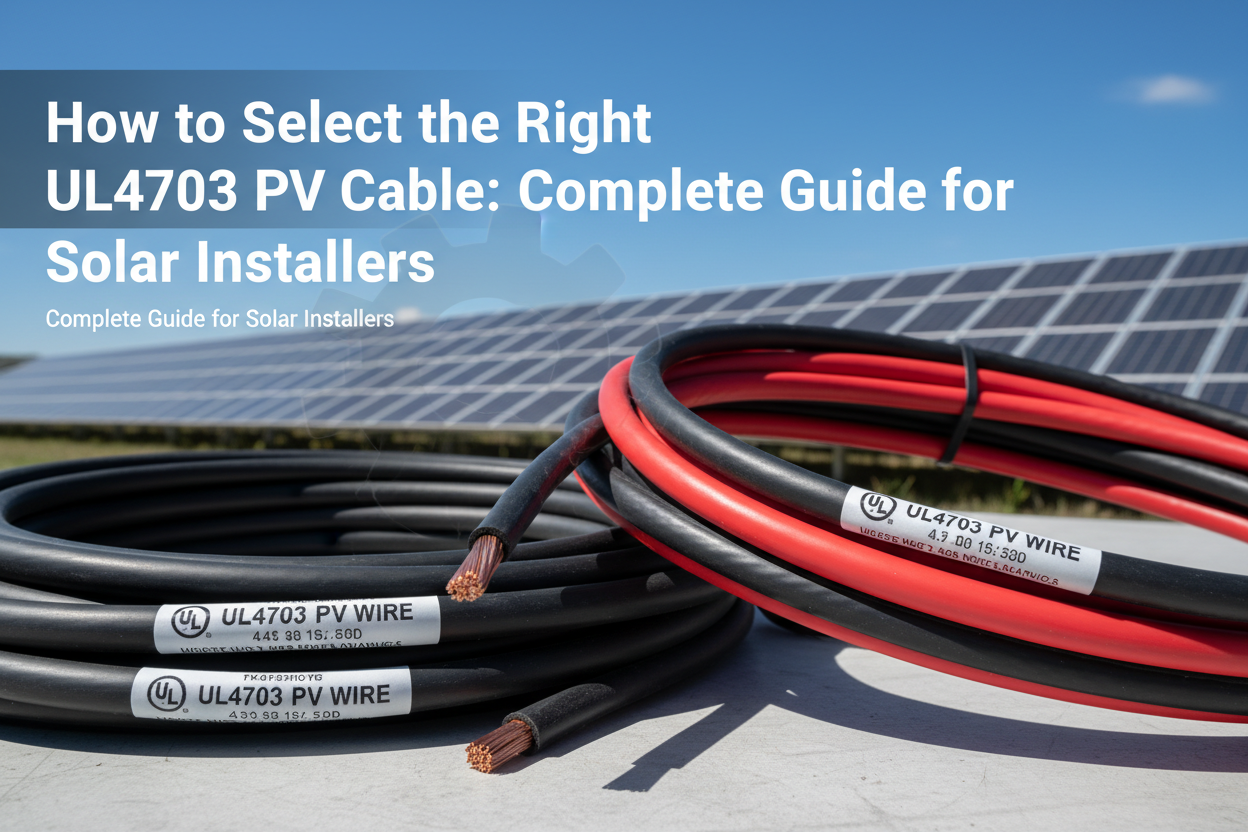
- Jacket marking — manufacturer, UL4703, PV WIRE, AWG size, voltage rating (1000V/2000V), temperature rating, sunlight resistant.
4. The 5 most common mistakes when buying PV cable
Mistake 1 — Confusing PV Wire with USE-2
USE-2 is an underground service-entrance cable. It is NOT certified for ungrounded PV systems and does not share the same UV resistance. If your local NEC jurisdiction requires PV Wire (as in most modern functionally-ungrounded systems), using USE-2 makes the installation non-compliant.
Mistake 2 — Buying "solar" cable without real UL certification
Many imported cables print "UL4703" on the jacket without having active laboratory certification. Always ask for the UL File Number (E-XXXXXX) and verify it for free at iq.ulprospector.com.
Mistake 3 — Choosing AWG by price, not by calculation
Downgrading from 10 AWG to 12 AWG to save 15–20% on the spool cost can burn 3–5% of annual production on long runs. Payback on the larger gauge is almost always under 2 years.
Mistake 4 — Not checking connector compatibility
Each solar connector brand has a specific cable outer-diameter range. A cable with a jacket thicker or thinner than spec causes poor sealing → moisture ingress → connector failure in 2–3 years. Always check the cable OD against the connector's accepted OD range.
Mistake 5 — Improper storage and handling
Even the best UL4703 cable gets damaged if exposed to temperatures below −20°C during transport and then pulled hard, or if stored outdoors for months before installation. Order quantities matched to your project and store in a dry, indoor location.
5. Final checklist before buying your UL4703 PV cable
- ✓ Jacket clearly shows: manufacturer, UL4703, PV WIRE, AWG size, voltage rating, 90°C WET / 150°C DRY, SUNLIGHT RESISTANT.
- ✓ UL File Number (E-XXXXXX) is verifiable on UL Prospector.
- ✓ Conductor is stranded copper with many fine strands (class 5 flexible).
- ✓ Insulation is dual-layer XLPE (primary + jacket).
- ✓ AWG gauge calculated per NEC 690.8 with temperature and bundling derating.
- ✓ Projected total DC voltage drop is < 2%.
- ✓ Cable outer diameter is compatible with your solar connector brand.
- ✓ Supplier provides a quality certificate and batch test report.
Conclusion: choose once, install right
A genuine UL4703 PV cable typically represents just 2% to 4% of the total cost of a solar system — yet it's responsible for 100% of the DC energy transport over 25 years. Cutting corners on this component is the fastest way to turn a profitable installation into a permanent callback.
Specifying and buying UL4703 PV cable with verified certification, correctly sized gauge, and quality XLPE insulation is the highest-leverage decision you can make on every project.
Certified UL4703 PV Wire — In Stock
6, 8, 10 & 12 AWG · Red and Black · 500 to 5,000 ft reels · Ships same or next business day from TX & CA.
Browse UL4703 Catalog →Questions about cable sizing?
Contact our team — free specification review for residential, commercial, and utility-scale projects. Response within 1 business day.
Contact Technical Support →